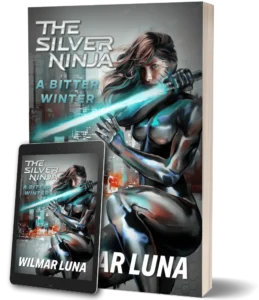
Once upon a time, back in 2002, little Wilmar came up with an idea for an original new superhero but never dreamed of being a writer or publishing it. Fast forward to 2012 after years of waiting, the big publishers never delivered on a new superheroine with the gravitas of a Batman and the spunky attitude of Spider-Man. So, he pulled the trigger and decided to publish The Silver Ninja. He was so proud and so happy of his work, he knew in his heart that everyone would love his book. He hired a publicity company, ordered books for distribution, and spread his great work to the world.
Unfortunately, The Silver Ninja did not usher in the new renaissance he had hoped for. The reviews of his great work were brutal, citing shallow characters, weird metaphors, and an annoying protagonist who was hard to root for. This was not the debut all writer’s dream of… it was a nightmare.
I did not know it at the time, but those initial reviews forever changed my writing process.
My book was a great embarrassment. I couldn’t read a single sentence from it without feeling cringe. I took the reviews and comments in stride, apologized to readers who may have been misled by my book, and promised to do better. On the surface, I played everything cool and even turned an awful metaphor into a running gag. Behind the scenes, I sat at my computer ready to pull the trigger on ending my short-lived author career. Desperate not to shame myself again, I re-evaluated my writing and sacrificed the purple prose. I removed the flowery language and replaced it with similes and brute, utilitarian language.
But without the poetry of the purple prose, the descriptions lost their magic. “Cindy is muscular. Jadie is blonde. Jonas is tall.” When I released The Silver Ninja: Indoctrination, I thought this would fix all the sins from the first book. But, no one read it. The reviews it did receive stated that the book was fun but shallow. It wasn’t worthy of the coveted 5 stars. B-movie shlock.
Embarrassed again, I tore everything down and started from scratch.
On a technical level, A Bitter Winter and Narco Hotel were a leap forward from stone age to the renaissance. Proper descriptions, show don’t tell, fleshed out characters, carefully structured plots, but something was still missing. Whenever I tried to look for awesome excerpts to post online, I could never find something that captured the magic of the first book.
Books I’ve read from my favorite authors have always had that one defining excerpt to convince someone to read more. But I could never find those magical excerpts in my own work. Where was that awesome, thrilling paragraph where I described the heart of the story in a beautiful and poetic way?
There was something readers of my original book said that I didn’t realize was a massive compliment and something I should have taken another look at. “I really enjoyed how it was written.” The purple prose.
There was another reader, a young man who read my first book as a boy. He said, “I was left with a question that’s been nagging me since I completed A Bitter Winter. Why did you start the whole thing over to begin with? Not the “worst book of 2012″ crap.”
There were readers out there who loved the first book because of -what I thought- were its flaws.
Fast forward to 2026, Sanctifiction: The Darkness at Home continues to frustrate me. Every rewrite, every edit, improves one aspect while damaging another. As the structure gets stronger, the prose weakens. It wasn’t until this month that I realize what I wish my book had. The poetic voice.
Purple prose without intent turns a straight forward novel into a convoluted verbose mess. However, if mastered, flowery prose can create mood and tone. Recently, I started beta reading for a friend and found myself in love with one particular piece of description. “Fingers of color pulled away the night sky.” That’s the kind of description I want in my books.
For a horror novel delving into the depths of the occult, rituals, madness and paranoia. A by the numbers description doesn’t feel right. Even if Stephen King himself wrote my book, his everyman voice wouldn’t match with my work.
So, I looked to Cormac McCarthy
There are two authors whose writing styles fill me with envy:
George R. R Martin who writes incredible descriptions that bring the world to life.
And Cormac McCarthy who evokes visceral emotions through his unpunctuated, brutal, yet oddly beautiful prose. An author who said f— commas and periods because they add clutter.
But Cormac McCarthy, his prose is absolute magic. I don’t know how he does it.
Don’t believe me? Here’s an excerpt from All the Pretty Little Horses:
“The boy who rode on slightly before him sat a horse not only as if he’d been born to it which he was but as if were he begot by malice or mischance into some queer land where horses never were he would have found them anyway. Would have known that there was something missing for the world to be right or he right in it and would have set forth to wander wherever it was needed for as long as it took until he came upon one and he would have known that that was what he sought and it would have been.”
Wow, just wow. Though it may seem poorly written at first glance, it isn’t long before you realize the author has given you the most complete description of a character without telling you anything physical about them. There’s no mention of what they look like, hobbies, or how they react around other people.
Yet, you intrinsically know that horses are the most important thing in this boy’s life and he was born to ride. Horses were so important to this boy that if they didn’t exist, he would have found them in order to feel like this is where he belonged.
How the f— do I write like that? Of all the different voices I’ve read, Cormac McCarthy is the only author I’ve ever wanted to sound like (RIP).
Maybe this is the voice I have been searching for.
Deep down, the boy who would be writer sought to breathe life into his creation, for he once dreamed of the heroine and answered the unignorable call to bring her into existence. But the boy was unmarked by the learned scars of time and the punishment of wisdom. His voice was articulate, but uncontrolled, unable to shape the clay into the magnificent sculpture he envisioned.
He held his creation, disappointed in its uneven limbs and lopsided head. It became nothing like he imagined. He ventured out into the woods and threw his hideous creation on the ground, burying it under a pile of rocks next to a river. Had he known the current of time would unearth the bones of his dreams, he would have made the mistake of burying it some place else.
Years later, the boy returned to the river as a man, marked with the wrinkles of time and a beard with flecks of gray. He found his creation, lying there in dirt yet somehow immune to the passage of time. He held the lumpy, misshapen figure in his hands and smiled as he remembered his innocence and the heart his young self put into his creation. A time when his naivety protected him from the cruelty of the world. He brushed the dirt off the clay figure with his calloused fingers and examined its form and design. The man realized the boy had not failed, he was simply too young to master his voice.
He needed the hardships of time to create the mold. An education and practice to create the chisel and hammer to carve the details. The man delicately carried the clay figure like a newborn babe and brought it home. He set it down on his workshop bench, for now he knew what needed to be done. After all these years, he had mastered his voice. He developed techniques and methods to build the proportions and fix the unevenness. A shave here, a cut there, the man sculpted the boy’s dream into reality. But he kept some of the flaws, because the imperfections were what made it uniquely his.
A young man with a dream.
(Damn this would have been perfect for the Advent Calendar!)
What I learned from publishing my first book in 2012
It took me 14 years to realize The Silver Ninja 2012 wasn’t a bad book. It was a product of its time and the best story I could write with the tools and education I had at that time. I needed to forgive myself for not being a writing genius.
My first book could have never lived up to the expectation I had of it. I also needed to accept that the readers who loved the book, -really- loved the book. I shouldn’t have been so quick to dismiss their compliments.
As a goodreads reviewer once said, and it remains one of my favorite reviews of all time:
Overall, it is a good read, and a pretty good attempt by the author considering it is his first book. There are some serious flaws in this work, but it does also have immense redeeming qualities as well. It is quite obviously a flaw of mismanagement of the novel rather than an intellectual flaw. An artistic issue, not an ideological one. And it is better it is not the other way round.